
Reach in target accounts
How many of your target accounts saw the ads.
Programmatic advertising
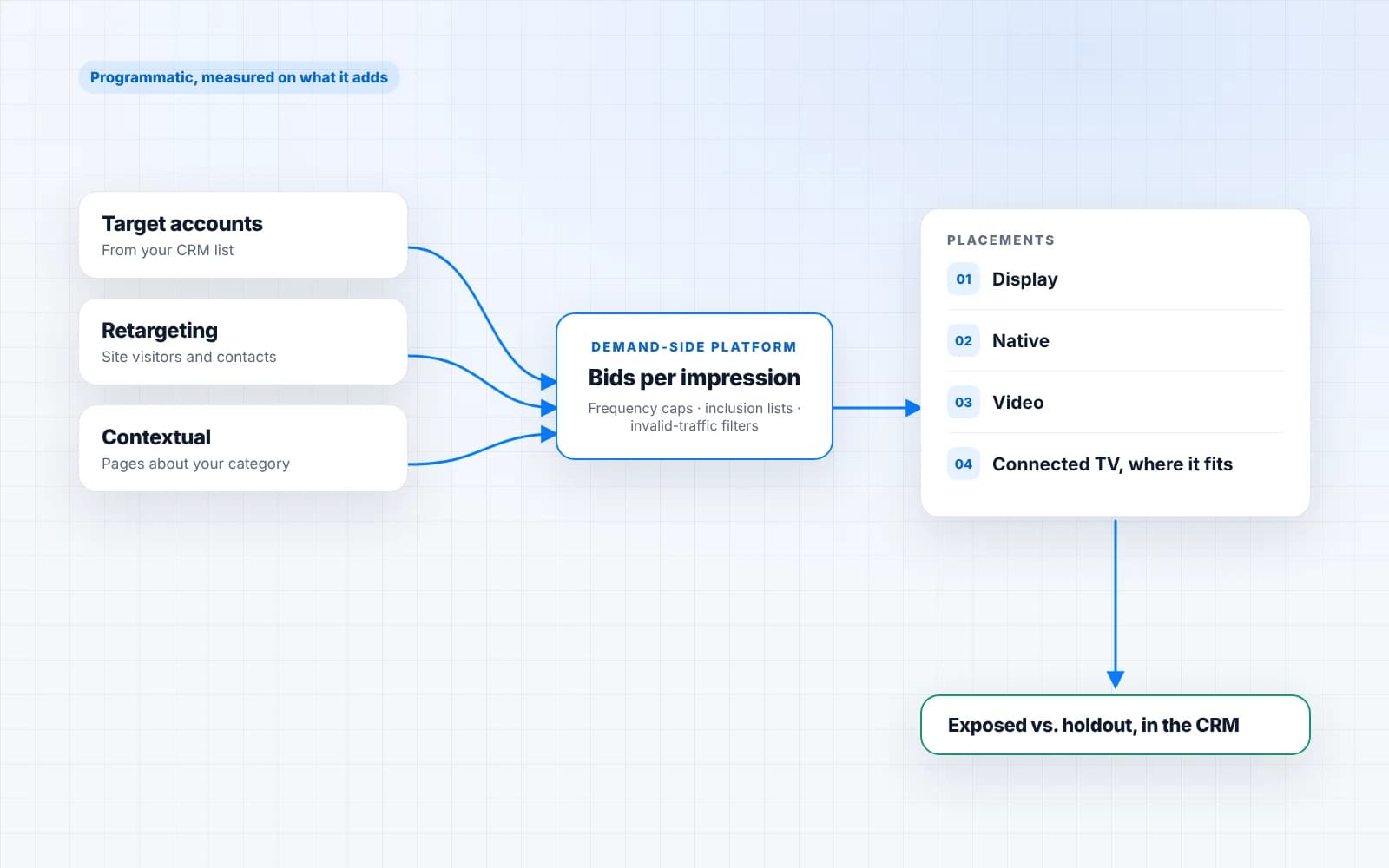
We plan and buy programmatic display, native and video through a demand-side platform, aim it at your target accounts and site visitors, and measure it against a holdout so you can see what it adds.
What we run
Senior-led · Measured on qualified pipeline














What's included
Programmatic works best for B2B when it supports search and LinkedIn: it keeps you in front of the accounts already researching, and it is measured the same way.
Ads served to people at the companies on your target-account list, so budget isn't spent on businesses you'd never sell to.
Stay in front of visitors and known contacts while they compare options, with frequency caps so it never becomes noise.
Placements next to content about your category, which doesn't rely on third-party cookies.
Formats that match the page or play in-stream, for explaining a product that needs more than a banner.
Controls on where ads can run and on the traffic you pay for.
Programmatic is judged on what it adds, not on view-through credit alone.
How it fits together
How we work
Target accounts, retargeting pools and contexts are agreed first, along with the question the budget has to answer.
Campaigns, creative, frequency caps, inclusion lists and traffic-quality filters are set before launch.
Part of the audience doesn't see ads, so the difference in engagement and pipeline shows what programmatic adds.
Placements, audiences and creative are reviewed monthly, and budget moves to what moves engaged accounts.
Reporting
Every report leads with the numbers your leadership team cares about, then what we changed and what we'll do next.
How many of your target accounts saw the ads.
Target accounts that visited your site or converted after exposure.
The difference between exposed and holdout audiences.
Where ads ran, and spend excluded as invalid traffic.
Your next growth opportunity
A senior strategist reviews your paid media and measurement, and tells you where programmatic would add pipeline and where it wouldn't.
FAQ
Programmatic advertising is buying ad placements automatically, impression by impression, through a demand-side platform. It covers display, native, video and connected TV across many websites and apps, targeted by audience, account or context.
Often, as a support channel. It works best alongside search and LinkedIn: keeping you visible to target accounts and recent visitors while they research. On its own, it rarely creates demand for a considered B2B purchase.
The Google Display Network is one ad network bought inside Google Ads. Programmatic buying through a demand-side platform reaches inventory across many exchanges, with more control over audiences, accounts and placements.
With inclusion and exclusion lists for sites and apps, content-category exclusions, invalid-traffic filtering and monthly placement reviews.
We compare exposed audiences with a holdout that doesn't see the ads, and report engaged accounts and pipeline from your CRM, rather than relying on view-through conversions alone.
Where it fits the goal and budget. Connected TV is a reach channel, so we use it for awareness among defined audiences and measure it with the same holdout approach.
Start with a Growth Gap Analysis. A senior strategist reviews your paid media and measurement and tells you whether programmatic belongs in your plan.
Related reading
Related services
Paid search, paid social and AI ads, managed to qualified pipeline
Paid media servicesMore qualified leads from the traffic you already pay for
Conversion rate optimization servicesVisibility, citations and recommendations in AI answers
GEO services